
Breeder snapshot
Raymond J Yoder – Greenridge Kennel is linked to 13 public inspection reports from USDA and Ohio.
Fresno, Ohio
Raymond J Yoder – Greenridge Kennel is linked to 13 public inspection reports from USDA and Ohio.
Inspection Dog Counts
Dogs countedInspection date
Raymond J Yoder – Greenridge Kennel is linked to 13 public inspection reports, carrying 28 inspector findings, from April 2022 to April 2026.
Across 11 inspections between April 2022 and April 2026, inspectors recorded between 39 dogs and 86 dogs at Raymond J Yoder – Greenridge Kennel. The most recent count was 86 dogs on April 2, 2026.
| Date | Licence | Type | Dogs counted | Inspector findings |
|---|---|---|---|---|
| April 11, 2022 | USDA 31-A-0905 | Pre-license inspection | 60 dogs | None |
| November 25, 2024 | Ohio CB002J75 | Routine inspection | 66 dogs | 8 findings |
| December 5, 2024 | USDA 31-A-0905 | Attempted inspection | No access | None |
| December 18, 2024 | USDA 31-A-0905 | Routine inspection | 67 dogs | 3 findings |
| December 30, 2024 | Ohio CB002J75 | Follow-up inspection | 39 dogs | None |
| April 14, 2025 | USDA 31-A-0905 | Re-license inspection | 73 dogs | 4 findings |
| April 15, 2025 | USDA 31-A-0905 | Re-license inspection | 70 dogs | None |
| July 10, 2025 | USDA 31-A-0905 | Routine inspection | 75 dogs | None |
| September 30, 2025 | USDA 31-A-0905 | Routine inspection | 86 dogs | 3 findings |
| November 25, 2025 | Ohio CB002J75 | Routine inspection | 71 dogs | 10 findings |
| December 17, 2025 | Ohio CB002J75 | Follow-up inspection | Not recorded | None |
| January 8, 2026 | USDA 31-A-0905 | Routine inspection | 71 dogs | None |
| April 2, 2026 | USDA 31-A-0905 | Routine inspection | 86 dogs | None |
66 dogs recorded (39 adults · 27 puppies).
Upon inspection one enclosure had two boards on the outside portion of the run that had warped and were no longer level. The licensee shall ensure the boards are fixed to be level. During the inspection the licensee was able to correct this issue. Corrected on: 11/25/2024
Upon inspection the licensee was not using an approved instrument to perform tail docking procedure. The licensee shall reach out to their veterinarian for instruction.
Upon inspection a female Yorkshire terrier was found to be purchased 05/23/2024. She whelped a litter of puppies on 10/25/2024. There was no proof of physical examination before this female was bred.
Upon inspection the licensee had old bottles of expired medication kept in the kennel, during the inspection the licensee stated they were not currently using any of the medications and was able to dispose of them. Corrected on: 11/25/2024
Upon inspection the licensee had multiple records of adult dogs and puppies removed from the premises without description. During the inspection the licensee was able to correct this issue. Corrected on: 11/25/2024
Upon inspection the licensee was not keeping up to date records of adult dogs on hand. To be corrected on: 12/25/2024
Upon inspection the licensee lacked all required physical examination records for males in the year 2023. To be corrected on: 12/25/2024
Upon inspection the licensee lacked proof of a full kennel brucella canis test as required by their veterinarian. To be corrected on: 12/25/2024
67 dogs recorded (38 adults · 29 puppies).
The facility is not maintaining adequate records of acquisition and disposition. Cage cards are used for acquisition records for litters of puppies; however, they do not contain all of the required information such as: USDA license number, individual puppy identification numbers, gender of each puppy, color, breed, and date of disposition as required by the Animal Welfare Act Regulations subpart 2.75(a)(1)(i-ix). Additionally, not all of the APHIS 7006 Record of Disposition forms evaluated during the inspection are being filled out completely. Approximately 15 forms from 2023 and 2024 were missing required information found in the Regulations under 2.75(a)(1)(i-ix), such as the date of disposition, the name and address of the person who purchased the dog and whether or not that person is licensed under the Act, the vehicle license number and State and the driver’s license number of the person who purchased the dog, method of transportation, and the method of disposition (sale, donation, etc). Accurate record keeping is essential so that APHIS inspectors can adequately identify the movement of dogs into and out of the facility, especially in cases of loss or theft. Each dealer shall make, keep, and maintain records for forms which fully and correctly disclose the information concerning each dog purchased or otherwise acquired, owned, held, or which is transported, sold, or otherwise disposed of by that dealer. The records shall include any offspring born to any animal while in his or her control. Correct by maintaining complete records for acquisition and disposition by December 25, 2024.
The licensee is not following the Program of Vet Care (PVC) for vaccinations in adult dogs. The Animal Welfare Act (AWA) requires vaccinations for contagious and/or deadly diseases of dogs, including rabies, distemper, and parvovirus. The facility’s PVC prescribes for the rabies vaccine to be given according to label directions, and for the distemper and parvovirus vaccines to be given yearly to adult dogs. None of the adult dogs at the facility are up to date on all three of the vaccines required by the AWA, nor do they have a prior history of vaccines. Failure to follow the PVC for vaccinations leaves the dogs susceptible to diseases, which, if contracted, would cause pain, distress, and suffering. It is also important for breeding dogs to be vaccinated because they will pass immunity from vaccines onto their offspring. Correct by administering all of the vaccines required by the Animal Welfare Act (distemper, parvovirus, and rabies) in accordance with a schedule approved by the Attending Veterinarian and vaccine manufacturer recommendations. Correct By: January 15, 2025, onward.
The facility has not retained copies of all medical records. The facility reports yearly fecal testing was completed during the kennel inspection by the Attending Veterinarian, with the most recent being completed on 4/24/24. However, the facility does not have a copy of the results for any of the fecal samples. Maintaining medical records assists APHIS inspectors in confirming adequate veterinary care is being provided to the regulated dogs at the facility. Dealers must keep copies of medical records for dogs, including the dates and findings/results of all screening, routine, or other required or recommended test or examination. Correct by: December 25, 2024, onward.
73 dogs recorded (37 adults · 36 puppies).
The facility is not maintaining adequate records of acquisition and disposition. Cage cards are used for acquisition records for litters of puppies; however, they do not contain all of the required information such as: individual puppy identification numbers, gender of each puppy, color, and date of disposition as required by the Animal Welfare Act Regulations subpart 2.75(a)(1)(i-ix). Additionally, not all of the APHIS 7006 Record of Disposition forms evaluated during the inspection are being filled out completely. There are 4 forms dated 2/20/25 (3) and 3/11/25 (1) that are missing required information found in the Regulations under 2.75(a)(1)(i-ix), including the name and address of the person who purchased the dog and whether or not that person is licensed under the Act, the vehicle license number and State and the driver’s license number of the person who purchased the dog, and the method of disposition (sale, donation, etc). Accurate record keeping is essential so that APHIS inspectors can adequately identify the movement of dogs into and out of the facility, especially in cases of loss or theft. Correct by ensuring each dealer shall make, keep, and maintain records for forms which fully and correctly disclose the information concerning each dog purchased or otherwise acquired, owned, held, or which is transported, sold, or otherwise disposed of by that dealer. The records shall include any offspring born to any animal while in his or her control.
Five puppies did not have access to water. The puppies were in two temporary housing enclosures (one housing two Cavapoos and two Yorkipoos, and one enclosure housing one Cockapoo) and so, the licensee didn't think they needed water for that short period of time (a few hours). The enclosures had neither a water bowl nor an automatic waterer. The licensee provided the puppies with water when asked to by the inspector. The puppies showed little to no interest in the water. Access to water is necessary to prevent dehydration, especially in young puppies who may not have a lot of stamina yet. Correct by ensuring potable water is continually provided to all dogs and puppies at all times.
The licensee is not following the Program of Vet Care (PVC) for vaccinations in adult dogs. The Animal Welfare Act (AWA) requires vaccinations for contagious and/or deadly diseases of dogs, including rabies, distemper, and parvovirus. The facility’s PVC prescribes for the rabies vaccine to be given according to label directions for adult dogs. None of the adult dogs at the facility are up to date on the rabies vaccines required by the AWA. Failure to follow the PVC for vaccinations leaves the dogs susceptible to diseases, which, if contracted, would cause pain, distress, and suffering. It is also important for breeding dogs to be vaccinated because they will pass immunity from vaccines onto their offspring. Correct by administering all of the vaccines required by the Animal Welfare Act (distemper, parvovirus, and rabies) in accordance with a schedule approved by the Attending Veterinarian and vaccine manufacturer recommendations.
There is no medical record for a dog being treated for an ear problem. A physical exam by the veterinarian dated 4/12/25 identified female French Bulldog #2612 had a left ear problem. The dog was prescribed Posatex to be given once a day for 7 days. The licensee reports he is applying the medicine; however, he has not created a medical record to reflect this. Accurate medical record keeping ensures adequate veterinary care can be assessed by USDA officials during inspection. Facilities must keep copies of medical records when a problem is identified which include the date and description of the problem, exam findings, test results, plan for treatment and care and treatment procedures performed when appropriate. Correct by ensuring the facility document all medical treatments for dogs.
86 dogs recorded (43 adults · 43 puppies).
The outside portion of a sheltered housing facility enclosure failed to safety contain a Cavapoo puppy (DOB 7/12/25). There is an approximately 4-5” space between the outer wall of the housing facility and the flooring of the outside enclosure that is used as a washdown gutter. It runs along the length of the kennel. The puppy went into that gutter area and entered the adjacent enclosure. The three small breed dogs in that kennel reportedly killed the puppy. The licensee reports this incident happened yesterday and he found the puppy deceased. Escaping from an enclosure can cause harm, injury, or loss of dogs and puppies. The housing facilities must be designed and constructed so that they protect the animals from injury and contain the animals securely. Correct by ensuring construction methods are used to ensure puppies are not able to get into the washdown gutter area and enter into other enclosures, and that all dogs are contained safely and securely. Correct by October 5, 2025.
The sheltered housing facility has 24 enclosures. Each enclosure has a metal front gate. Each gate contains numerous areas of excessive rust. The paint that had been in these areas is now replaced with rust and the rust is flaking and peeling. This kind of surface cannot be properly sanitized. Excessive rust, if not corrected, could also affect the structural strength of the gates. Correct by ensuring the metal surfaces are maintained so that proper sanitization can occur, such as sealing the rusted areas, or removing and replacing the gates if they cannot be reconditioned. Correct by: October 30, 2025
The licensee did not retain copies of medical records for heartworm and adult dog fecal testing from 4/11/25. The inspector called the office of the Attending Veterinarian, and they confirmed testing had been completed on that date, however, the licensee did not have records from then. Dealers are required to keep copies of medical records for all dogs and make the records available for APHIS inspection. APHIS inspectors use this documentation to ensure that adequate veterinary care was provided to the dogs. Correct by ensuring the dates and findings/results of all screening, routine or other required or recommended test or examination is recorded and retained. Correct by: October 30, 2025.
71 dogs recorded (43 adults · 28 puppies).
Two enclosures had open wire flooring that was missing sections of coating on the wire. To be corrected on: 12/23/2025
The licensee had one male in with the dam and litter of puppies. The licensee corrected this issue during the inspection. Corrected on: 11/25/2025
One enclosure had a puppy under 4 months of age housed with two adult dogs. The licensee corrected this issue during the inspection. Corrected on: 11/25/2025
The licensees representative used unacceptable instruments to tail dock a litter of puppies in 2025. The licensee failed to use the correct instruments that is required for tail docking. This matter will be referred to ODA’s Legal Counsel due to the repetitive occurrence of the violation and the licensee being put on previous notice.
Upon inspection a female ending in microchip #8544 lacked a physical exam prior breeding around 9/8/25. Her previous litter was whelped on 5/9/25. The licensee failed to get a physical exam that was required before breeding. This matter will be referred to ODA’s Legal Counsel due to the repetitive occurrence of the violation and the licensee being put on previous notice.
Upon inspection a female ending in microchip #6772 lacked a physical exam prior breeding around 9/21/25. Her previous litter was whelped on 4/27/25. The licensee failed to get a physical exam that was required before breeding. This matter will be referred to ODA’s Legal Counsel due to the repetitive occurrence of the violation and the licensee being put on previous notice.
Upon inspection a female ending in microchip #8879 lacked a physical exam prior to breeding around 9/6/25 for her first litter. The licensee failed to get a physical exam that was required before breeding. This matter will be referred to ODA’s Legal Counsel due to the repetitive occurrence of the violation and the licensee being put on previous notice.
The licensee had two expired drugs that were not used. The licensee corrected this issue during the inspection. Corrected on: 11/25/2025
One adult dog was not properly identified. The licensee corrected this issue during the inspection. Corrected on: 11/25/2025
The licensee followed corrective measures for 11 dogs with dental disease but did not document that they followed it. The licensee corrected this issue during the inspection. Corrected on: 11/25/2025
1 photograph taken by inspectors at Raymond J Yoder – Greenridge Kennel and attached to their reports.
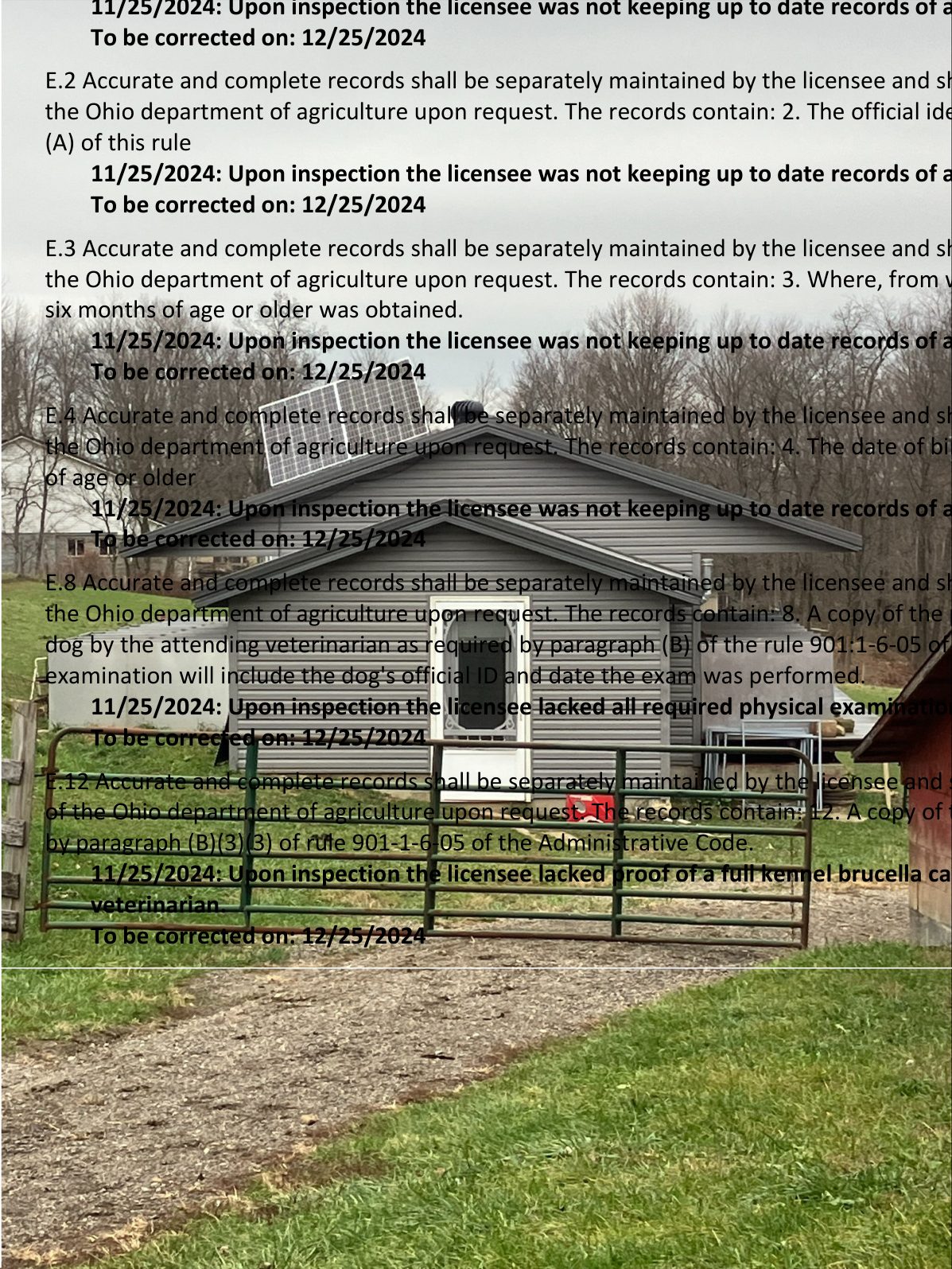
November 25, 2024 — Ohio inspection (report PDF)
Yes. Inspectors recorded 28 problems across 13 visits, 2 of them repeats of earlier ones. Each one is quoted in full above, in the inspector's own words.
At the most recent inspection on file, April 2, 2026, inspectors counted 86 dogs (41 adults · 45 puppies). The count is taken by the inspector on the day, so it moves with litters and sales.
The records name Beagle, Cavapoo, Cockapoo, French Bulldog, Soft Coated Wheaten Terrier, Yorkie, Yorkipoo. Breeds come from the inspection paperwork, so a kennel may keep others that were never written down.
This profile includes public USDA and Ohio inspection and licensing records. Notes describe conditions documented on the inspection dates shown.
If information is inaccurate or out of date, please let us know.
Submit a correctionWe collect and organize public records from government sources, including USDA APHIS and state departments of agriculture. We do not conduct our own inspections.
Learn how our data works →They summarize public licensing and inspection records from the agencies shown.
Records are updated as new public documents are collected and reviewed.
No. Pawthenticity organizes public records and does not provide endorsements.
Pawthenticity is a nonprofit organization. Your support helps us make public records more accessible.
Real records. Brighter tomorrows.